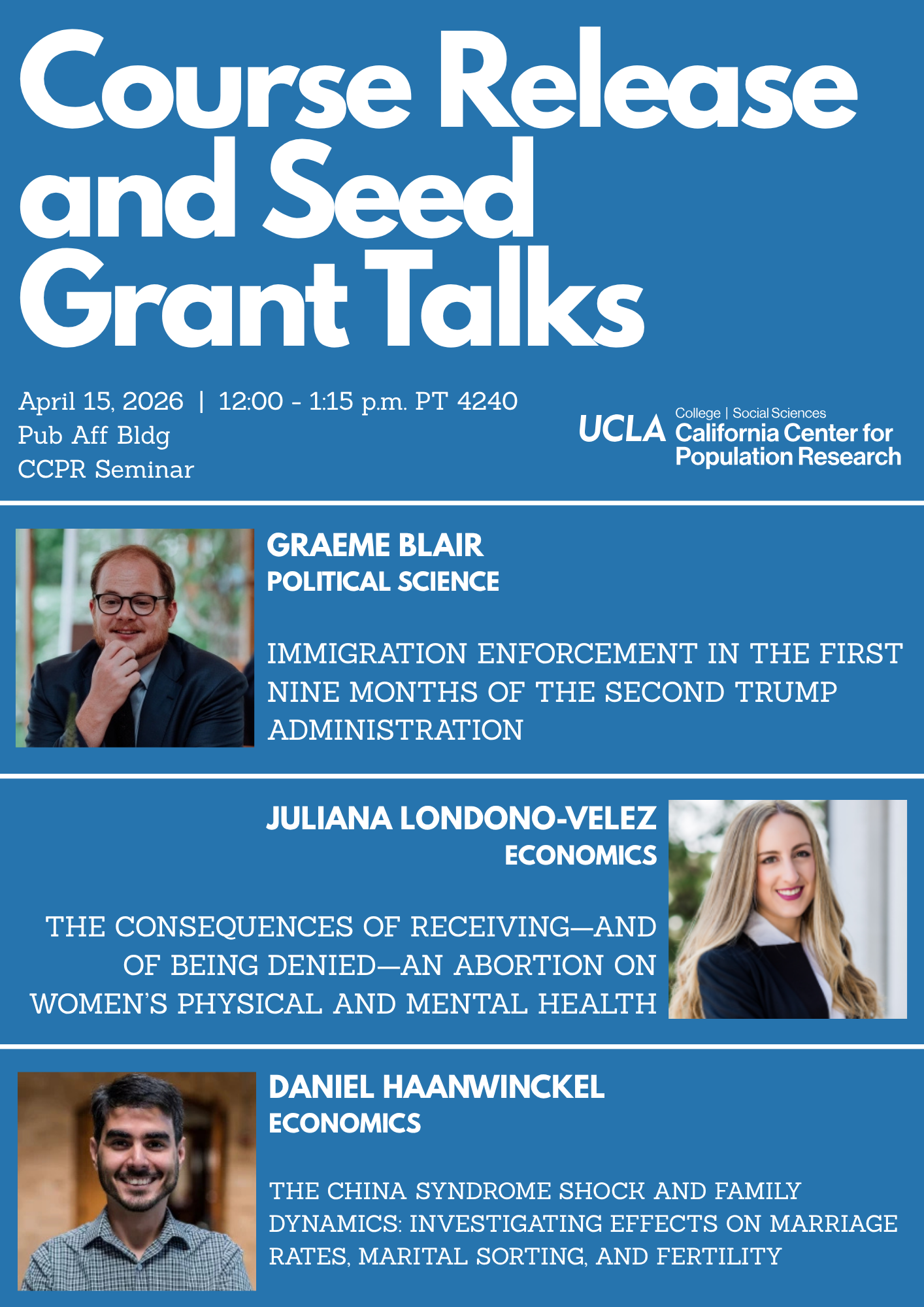
“Immigration Enforcement in the First Nine Months of the Second Trump Administration”
Seed Grant Recipient: Graeme Blair
Professor of Political Science
Biography: Graeme Blair is a professor of political science at UCLA and faculty affiliate in statistics and the California Center for Population Research. Blair is Co-Director of the Deportation Data Project. He studies state violence and how to make social science more credible, ethical, and useful. Blair’s book Research Design in the Social Sciences was published in 2023 by Princeton University Press and won the best book award from the American Political Science Association Experiments Section. Blair’s second book, Crime, Insecurity, and Community Policing, was published in 2024 by Cambridge University Press in the Studies in Comparative Politics series. His articles are published in journals including Science, Proceedings of the National Academy of Sciences, American Political Science Review, American Journal of Political Science, Journal of Politics, Journal of the American Statistical Association, and Political Analysis. Blair’s statistical software, including DeclareDesign, has been downloaded over a million times. He is the recipient of awards including the Leamer-Rosenthal Prize for Open Social Science and the Society for Political Methodology best statistical software award.
Abstract: The number of deportations from within the United States, away from the border, increased by a factor of 4.6 during the first nine months of the second Trump administration (the period for which we have detailed data). That increase reflects the following key trends: First, ICE arrests quadrupled, including both street arrests and transfers from criminal custody to ICE immigration custody. ICE street arrests (i.e. arrests not at jails) went up by over a factor of eleven. Street arrests at this order of magnitude are a new phenomenon. For both types of arrests, ICE was much less likely to target people with criminal convictions. These changes led to over a sevenfold increase in arrests of people without criminal convictions. Second, the quadrupling (4x) of arrests resulted in an even larger rise (4.6x) in deportations because of increased detention space and decreased releases. The administration roughly tripled the number of detention beds used for people arrested within the United States. That capacity increase was a result both of new funding (for new detention centers and more beds in existing detention centers) and of a decrease in arrests at the border. Once arrested, few were released. Release within 60 days of arrest, already rare in the last six months of the Biden administration (16%), became almost nonexistent (3%). The rate of deportation within two months of initial detention rose by about a quarter, from 55% to 69%; the declining release rate accounted for most of that increase. Perhaps because of the lower release rate, voluntary departures (which are rare compared to removals) increased by 21 times.
“The Consequences of Receiving—and of Being Denied—an Abortion on Women’s Physical and Mental Health”
Seed Grant Recipient: Juliana Londono-Velez
Assistant Professor of Economics
Biography: Juliana Londoño-Vélez is an applied microeconomist. Her research focuses on how tax and social policies can reduce poverty and inequality and promote upward mobility in Latin America.
Abstract: This paper estimates the causal effects of being denied an abortion on women’s physical and mental health. We exploit Colombia’s tutela system, which allows women to petition judges to compel insurers and providers to deliver timely abortion care. Linking all abortion-related tutelas to comprehensive administrative health records, we leverage the random assignment of cases to judges with differing leniency in an instrumental-variables design. Abortion denial sharply reduces access to abortion services. Consistent with the importance of timely care, women who seek abortions in the second or third trimester face substantially higher medical risks—including hemorrhage, uterine perforation or damage, and septicemia—than women who seek care in the first trimester. We find no evidence that obtaining an abortion worsens women’s mental health. By contrast, abortion denial causes large and persistent increases in mental-health diagnoses and psychotropic medication use, increases physical morbidity, and leads to sustained growth in health-care utilization, including emergency department visits. Finally, abortion denial reduces subsequent contraceptive use.
“The China Syndrome Shock and Family Dynamics: Investigating Effects on Marriage Rates, Marital Sorting, and Fertility”
Course Release Recipient: Daniel Haanwinckel
Professor of Economics
Biography: Daniel Haanwinckel is an Assistant Professor of Economics at UCLA. His research primarily focuses on the determinants of wages, unemployment, underemployment, and worker-firm sorting. He received his Ph.D. in Economics from the University of California, Berkeley in 2019.
Abstract TBA