

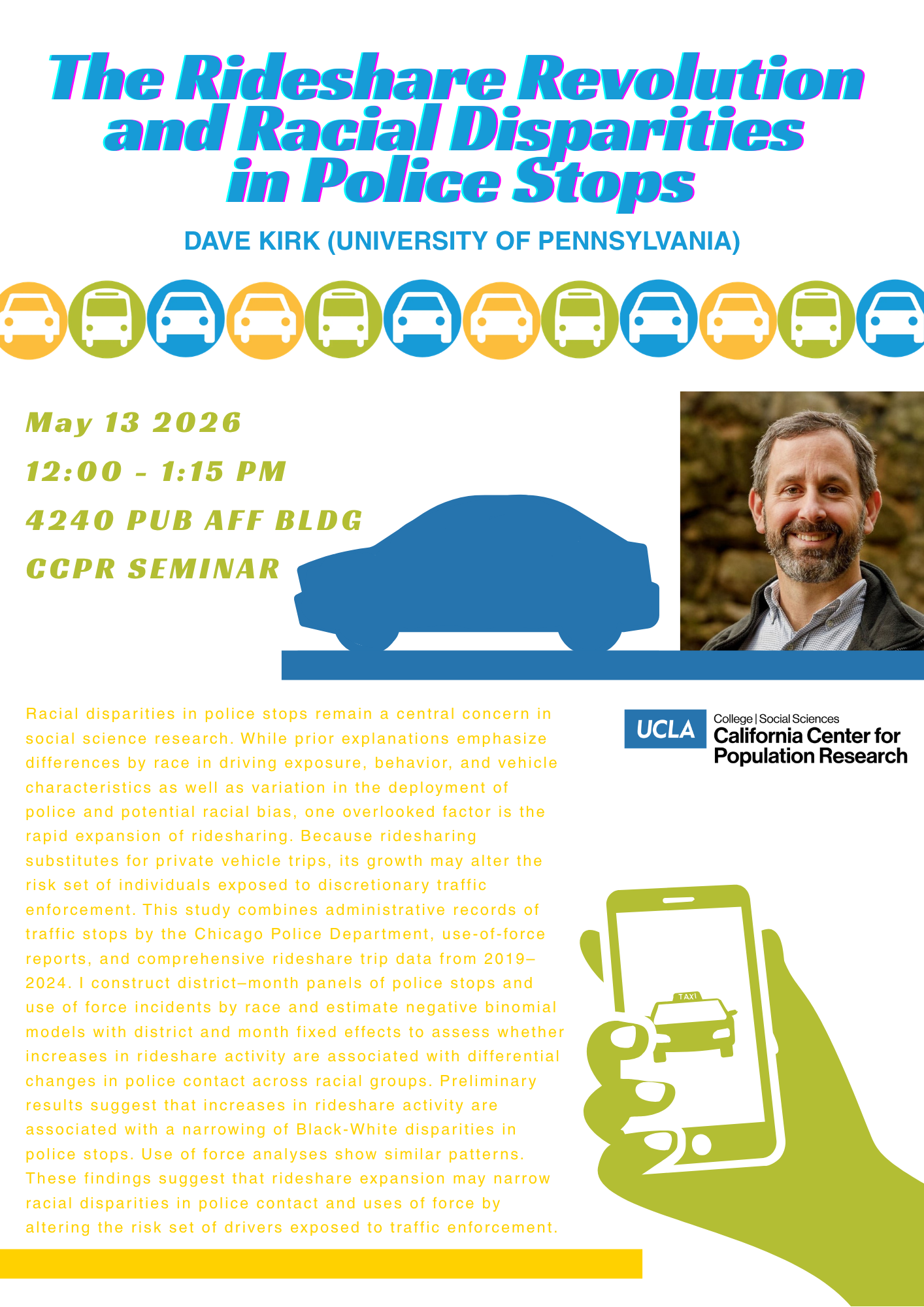
Biography: Dave Kirk is Professor and Department Chair in the Department of Criminology and Research Associate of the Population Studies Center at the University of Pennsylvania. He received his Ph.D. in sociology from the University of Chicago and previously served on the faculties at the University of Oxford, the University of Texas at Austin, and the University of Maryland. Kirk’s research agenda is primarily organized around three interrelated themes: the causes and consequences of cynicism and distrust of the police and the law, solutions to criminal recidivism, and the causes and consequences of gun violence. He is also interested in the implications of the rise of the sharing economy for crime and public safety. He currently serves as an Associate Editor of Criminology.
The Rideshare Revolution and Racial Disparities in Police Stops
Abstract: Racial disparities in police stops remain a central concern in social science research. While prior explanations emphasize differences by race in driving exposure, behavior, and vehicle characteristics as well as variation in the deployment of police and potential racial bias, one overlooked factor is the rapid expansion of ridesharing. Because ridesharing substitutes for private vehicle trips, its growth may alter the risk set of individuals exposed to discretionary traffic enforcement. This study combines administrative records of traffic stops by the Chicago Police Department, use-of-force reports, and comprehensive rideshare trip data from 2019–2024. I construct district–month panels of police stops and use of force incidents by race and estimate negative binomial models with district and month fixed effects to assess whether increases in rideshare activity are associated with differential changes in police contact across racial groups. Preliminary results suggest that increases in rideshare activity are associated with a narrowing of Black-White disparities in police stops. Use of force analyses show similar patterns. These findings suggest that rideshare expansion may narrow racial disparities in police contact and uses of force by altering the risk set of drivers exposed to traffic enforcement.