

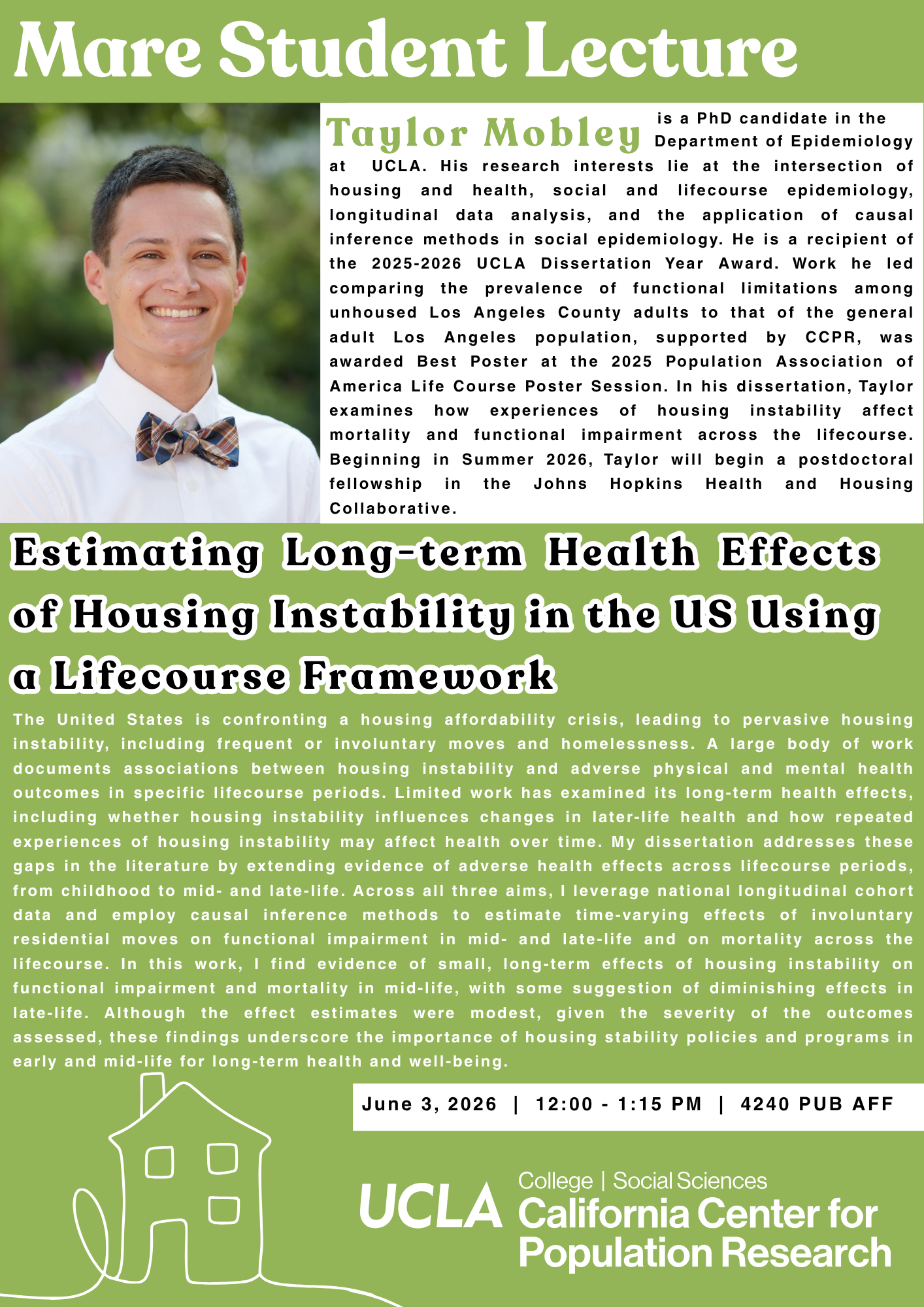
Biography: Taylor Mobley is a PhD candidate in the Department of Epidemiology at UCLA. His research interests lie at the intersection of housing and health, social and lifecourse epidemiology, longitudinal data analysis, and the application of causal inference methods in social epidemiology. He is a recipient of the 2025-2026 UCLA Dissertation Year Award. Work he led comparing the prevalence of functional limitations among unhoused Los Angeles County adults to that of the general adult Los Angeles population, supported by CCPR, was awarded Best Poster at the 2025 Population Association of America Life Course Poster Session. In his dissertation, Taylor examines how experiences of housing instability affect mortality and functional impairment across the lifecourse. Beginning in Summer 2026, Taylor will begin a postdoctoral fellowship in the Johns Hopkins Health and Housing Collaborative.
Estimating long-term health effects of housing instability in the US using a lifecourse framework
Abstract: The United States is confronting a housing affordability crisis, leading to pervasive housing instability, including frequent or involuntary moves and homelessness. A large body of work documents associations between housing instability and adverse physical and mental health outcomes in specific lifecourse periods. Limited work has examined its long-term health effects, including whether housing instability influences changes in later-life health and how repeated experiences of housing instability may affect health over time. My dissertation addresses these gaps in the literature by extending evidence of adverse health effects across lifecourse periods, from childhood to mid- and late-life. Across all three aims, I leverage national longitudinal cohort data and employ causal inference methods to estimate time-varying effects of involuntary residential moves on functional impairment in mid- and late-life and on mortality across the lifecourse. In this work, I find evidence of small, long-term effects of housing instability on functional impairment and mortality in mid-life, with some suggestion of diminishing effects in late-life. Although the effect estimates were modest, given the severity of the outcomes assessed, these findings underscore the importance of housing stability policies and programs in early and mid-life for long-term health and well-being.